Atarashii Historia
Production year: 2013-
Format: Installation
Size: Sushi (including ingredients) ... W2000 x H100 x D1800 Sushi clogs ... W3000 × H450 × D2000 (mm)
Material: mixed media


Atarashii Historia is a participatory artwork created through a collaborative project between Satsuki Imai and Kampung Lali Gadget, an educational organization based in Sidoarjo, Indonesia. The work intertwines Jamuran, a traditional Indonesian singing game, Indonesian traditional foods, and Imai’s Human Sushi series, creating a new playground where cultural practices and forms of play from Indonesia and Japan intersect. Through participation and collective action, the work explores new possibilities for connection and exchange across cultural boundaries.
About the Title “Atarashii Historia”
The work is inspired by four traditional dishes: Wedang (a traditional herbal drink), Lapis (a layered steamed cake), and Ingkung (a traditional chicken dish) from Indonesia, alongside sushi from Japan. Through playful interactions with one another, participants experience what it is like to “become” these foods, creating an embodied encounter with and between the cultures of the two countries.
Atarashii Historia was presented at the Biennale Jatim XI in Gresik, Indonesia, from August 24 to September 20, 2025.
The title Atarashii Historia is a coined phrase that combines the Japanese word atarashii (“new”) with the Indonesian word historia (“history”). In Japanese, the title would mean “a new history” (atarashii rekishi), while in Indonesian it would be expressed as historia yang baru.
The title emerged from Imai’s ongoing cultural exchange and research in Indonesia. During a visit to a museum dedicated to traditional games, she encountered historical accounts of the Japanese occupation of Indonesia. Reflecting on this complex history, she shared her thoughts with members of Kampung Lali Gadget, who responded, “We can create a new history ourselves.”
This conversation became the foundation of the project. The title Atarashii Historia expresses a shared aspiration to build new histories together through cultural, educational, and artistic exchange. The work was conceived as a starting point for creating new relationships and forms of collaboration between people, communities, and cultures.


Play Video
Play Guide Video (Japanese subtitles available). The video explains how participants engage with and play each of the food-based activities in Atarashii Historia.
Structure of Atarashii Historia
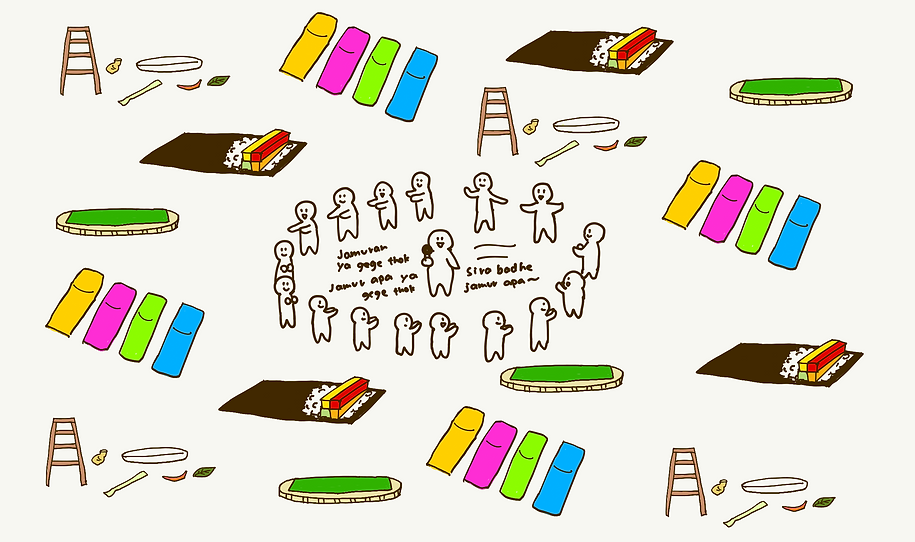
Inspired by Imai’s signature participatory work Human Sushi, Atarashii Historia reimagines the traditional Indonesian game Jamuran through a collection of sculptural objects based on traditional foods from Indonesia and Japan. The work consists of:
-
Jamuran, a traditional Indonesian singing game.
-
"Food-inspired sculptural play objects, modeled after traditional dishes from Indonesia and Japan and designed to create new ways of playing and interacting within the game.
Element 1: Jamuran
Jamuran is a traditional singing game from Java, Indonesia. Participants form a circle and walk while singing together. A player standing in the center acts as a leader and gives instructions such as, “Form a pair and carry each other on your back!” or “Form a group of three and become a truck!” Participants then collaborate with those around them to complete the task. The video below shows a Jamuran session that Imai observed during her research visit to Indonesia in 2024.
Element 2: Four Traditional Foods from Indonesia and Japan
For Atarashii Historia, Imai incorporated traditional foods from both Indonesia and Japan as key elements within Jamuran. The work features Norimaki (sushi rolls) from Japan, and Wedang (a traditional herbal drink), Lapis (a layered rice cake), and Ingkung (a ceremonial chicken dish traditionally served during religious and communal gatherings) from Indonesia.
Inspired by Imai’s Human Sushi series, each food was recreated as a life-sized sculptural object large enough for participants to enter and embody the food itself. To accommodate a large number of participants, four versions of each food were produced, resulting in a total of sixteen objects. This allowed up to sixteen people to participate in the game simultaneously.

Norimaki (Sushi Roll)
A traditional Japanese dish made by spreading rice over a sheet of nori (seaweed), placing ingredients such as egg, tuna, and dried gourd strips (kanpyo) on top, and rolling them together.

Lapis
A traditional Indonesian layered rice cake characterized by its colorful striped appearance.

Wedang
A traditional Indonesian herbal drink known for its nourishing qualities. It is typically made with herbs and spices native to Indonesia, such as ginger, cardamom, and cloves.

Ingkung
A traditional Indonesian chicken dish prepared using a whole chicken and commonly served during religious ceremonies and communal celebrations. It is traditionally presented on a woven bamboo tray known as a tampah.
■ The Four Food-Based Play Objects ■
1. Human Sushi
As part of the experience, participants run toward the giant sushi roll. One participant lies down on the “rice,” while the others work together to roll them up, creating a giant Human Sushi.
The nori (seaweed) section was constructed using reclaimed materials sourced from Kampung Lali Gadget. The rice grains were made from both recycled and newly purchased Styrofoam, with approximately 1,200 grains produced for the work. The sushi fillings were fabricated by local craftspeople who make cushion covers and other textile products in the Sidoarjo area.


2. Wedang
Wedang is a traditional Indonesian herbal drink made from ingredients such as ginger, cinnamon, bay leaves, and other aromatic herbs and spices.
Participants hold enlarged sculptural versions of these ingredients and enter a giant cup decorated with the marbled pattern often found on Wedang cups. One participant, carrying a large lemongrass stalk, stands on a chair and stirs the contents of the cup as if preparing the drink. As the cup is stirred, the participants inside move together, becoming the ingredients of the beverage itself.
For the production of the work, the cup was made from custom-printed fabric featuring a marbled pattern, while the ginger, lemongrass, and other ingredients were constructed primarily from recycled cardboard and other reclaimed materials.


3. Lapis
Lapis is a traditional Indonesian steamed cake known for its colorful layered stripes.
In this work, participants enter sleeping-bag-like fabric structures, each representing a different color of the cake. By lying down side by side and pressing their bodies together, they collectively become a giant Lapis. The closer they move together, the more closely they resemble the layered cake, often resulting in laughter and playful interaction.
The fabrics were purchased at a market in Sidoarjo and sewn by the mother of Achmad Irfandi, director of Kampung Lali Gadget, who works professionally as a dressmaker.


4. Ingkung
Ingkung is a traditional Indonesian dish prepared using a whole chicken and is commonly served during religious and ceremonial gatherings.
To perform Ingkung, two participants become the cooked chicken itself, while two others take on the role of cooling the dish by fanning it with their hands. Together they recreate the preparation and presentation of the meal through collective movement and play.
The giant tampah—a woven bamboo tray traditionally used to serve Ingkung—measures approximately 1.5 meters in diameter. It was specially commissioned and handcrafted by local bamboo artisans in Sidoarjo.


Project Process
Over the course of approximately one month, from August 9 to September 11, we carried out meetings, site visits, material gathering, production, play-testing, video editing, installation, exhibition preparation, and a public participatory event. The following section documents the project chronologically.
Meetings at Kampung Lali Gadget
Shortly after arriving in Indonesia, Imai began meeting with the Kampung Lali Gadget team (Irfandi, Nizar, Gista, Alfian, and Dany).
Although Imai had shared an initial proposal before her arrival, the team developed and expanded the ideas further. Through discussions, demonstrations, and collaborative planning, the direction of the project gradually took shape.


Site Visit
The team visited Pudak Gallery Gresik, the venue for the Biennale. As the gallery is located near the coast, members of the Biennale team introduced us to local fishermen, who generously shared their stories and treated us to local seafood dishes.
The venue featured a large open atrium, which was selected as the location for the public play event.


Further Meetings and Material Collection
After visiting the venue, we held additional meetings to determine the materials required for each of the four food-based works.
One of our first destinations was a recycling and surplus-material collection center. There we found unused rolls of corrugated cardboard and other materials that could be purchased at very low cost. For Imai, who had never sourced materials from such facilities in Japan, the experience offered a fresh perspective on local methods of production and resource use.


Production
Producing four versions each of Human Sushi, Lapis, Wedang, and Ingkung—a total of sixteen large-scale participatory objects—within two weeks was an ambitious undertaking.
In addition to the members of Kampung Lali Gadget, university students participating in internships joined the production process. Together, the team completed all sixteen works in approximately two weeks.
For Human Sushi, the challenge was to recreate the experience of the original work using locally available materials rather than those used in previous versions. For the other three works, which were being created for the first time, discussions focused on both construction methods and participant safety. Throughout the process, the team repeatedly asked how the works could be both enjoyable and safe for public participation.


Collaboration with Local Artisans
Several components of the project were produced in collaboration with local craftspeople.
The sushi fillings were fabricated by artisans who normally make cushions and bed covers. Although they explained that they rarely create rectangular forms such as those required for the project, they adapted their skills to realize the pieces.
The large bamboo tampah trays used for Ingkung were commissioned from local bamboo artisans. While they typically produce trays measuring only 30–40 cm in diameter, they created four trays measuring 1.5 meters in diameter within only a few days, large enough for participants to enter and interact with.


Play-Testing
Throughout production, the team repeatedly tested and revised the works.
The size of the Lapis fabric structures was adjusted, requiring additional fabric purchases. The Wedang cup was initially planned as a cardboard structure assembled from painted panels, but was later redesigned using custom-printed fabric. Each day involved experimentation, revision, and problem-solving.
Throughout the process, the team continually emphasized one shared principle: participants must be able to experience the work safely. Visual appearance and safety were evaluated together at every stage of development.


Completion of the Works
Once the works were completed, the team conducted final play-tests and documentation photography.
Video Production
Several members of the team had experience in filmmaking. Together, we gathered footage recorded throughout the project and collaboratively produced a documentary video documenting the process and the completed work.


Preparing for the Exhibition
The exhibition venue was located about two hours from Kampung Lali Gadget by car. After preparing the works for transport, the team traveled to the venue together and completed the installation.


Exhibition Opening
After successfully installing the works, the team participated in the exhibition opening.


Team Interviews
A documentary video was also produced featuring interviews with Kampung Lali Gadget members Irfandi and Nizar, alongside Imai, as well as footage from the project activities.
The interviews address the origins of the collaboration, challenges related to language and cultural differences, and the difficulties of balancing the project alongside Kampung Lali Gadget’s regular educational programs. The film presents reflections from the project's core members and offers insight into the collaborative process.
(Approx. 15 minutes. Directed by Muhammad Alfian Nur Riski.)
Exhibition and Public Event at Biennale Jatim
Atarashii Historia was exhibited at Biennale Jatim at Pudak Gallery Gresik, Indonesia, from August 24 to September 20, 2025. A public event was held on September 6.
During the event, visitors were invited to experience the artwork through participation and play. In addition, the four foods that inspired the work—Norimaki, Wedang, Lapis, and Ingkung—were prepared and served to participants. Visitors were able not only to embody the foods through play, but also to share them together through eating.
By bringing together play and food traditions from Indonesia and Japan, the event created a space for cultural exchange and collective experience.


Credits
I would like to express my sincere gratitude to everyone who contributed to this project.
Satsuki IMAI
Kampung Lali Gadget Team
Achmad Irfandi
Ahmad Nizar Pratama
Muhammad Alfian Nur Riski
Alkurnia Faiva Agista
Achmad Dani Nur Fajri
Dandy Wahyu Kurniawan
Andrey Setyowahyudi
Kharisma Nata Fambudi
Shinya Permatasari
Siti Nur Aini
Fahma Rossadah
Fajar Agustianto
Arizaldi Febiandika Styobudi
Novanto Azizul Hakim
Sutiyono
Siti Mas Udah
Giofani Saktiawan Imanmudin
Achmad Arga Afriatullah
Students of the Department of Communication Studies (IKOM),
UNESA (State University of Surabaya) and
UMSIDA (Muhammadiyah University of Sidoarjo)
Dzawis Sajaya
Emiliya Putri Salsabilah
Exsya Makou Herdimawan
Fadila Nurhamidah
Dian Rahmayanti
Divia Rahmadina
Anindya Rihhadatul Aisy
Lina Ziyadah
Nur Riska Yogi Maulani
Aprilia Ananda
Lutfia Nabila Wijiati
Nabila Nasywa
Andini Kurniawati
Dita Maulidiyah
Gracio Pardomuan Kristian Raharjo
Amanda Octavia
Bamboo Tampah (Serving Tray) Maker
Mahmud
Human Sushi Topping Production
Kasur busa al misfalah
Special Thanks
Triansyah ilhamzah
Halimatus sa’diyah